Jews are a minority. Many, perhaps most of us, have little or no involvement with “organised religion”. And among those who do observe religious rituals, there are many who keep rigorously silent about Israel’s crimes, whether out of embarrassment or because they genuinely support Netanyahu’s apartheid regime.
Despite all this, a minority of the minority decided to try and create a tranquil and welcoming space where we can observe Jewish customs without being subjected to Zionist harangues.
Those of us who sometimes play leading roles in this alternative Jewish space may give the impression that we know what we’re doing: that we’re confident with Hebrew, au fait with minhag (Jewish custom), and firm in our commitment to anti-Zionism and its theoretical underpinning.
In reality, we’ve reached this position from different starting points and by different routes. We’d love to hear from other participants about how you came to be involved in our non-Zionist minyan. Meanwhile, here’s my contribution.
Benny Ross
I was born in London in 1957 – twelve years after the war ended and ten years before most British Jews began to adopt the aggressive Zionism that so painfully characterises our religious authorities now. Many adults around me spoke with Yiddish, Polish, German, Austrian or Czech accents and had come to Britain as refugees, never speaking of the parents, siblings, friends, partners and children they had lost to the Nazi murderers. The Holocaust hung heavy over Jewish communities, and it seemed unquestionable that we needed Israel as a refuge that would always accept Jews who might have to flee from persecution anywhere else.
Several phrases that I learned in those days have stuck with me for half a century: The only democracy in the Middle East; A country the size of Wales (surrounded by the vast expanse of Arab states); Making the desert bloom; and above all, the Zionist project to give “to a people without a land, a land without a people”. I was not an exceptionally stupid child, yet it didn’t occur to me to wonder why a land without people was in dispute between Israelis and Palestinian Arabs. How could a population that didn’t exist fill the refugee camps in neighbouring countries and produce the terrorist movements we were taught to fear? If refugees were mentioned, it was always to declare that the Arab regimes kept Palestinians in camps in order to cynically make a political point against Israel in the eyes of the world.
Zionism had become hegemonic for us, as defined by Ilan Peleg in Victimhood Discourse in Contemporary Israel: ‘a prominent set of ideas in society that the vast majority of the people [read: British Jews] cannot even contemplate to challenge.’ So much so, that when I had the chance of what is now called a gap year before university, I worked in London for a few months and spent the rest of 1975-76 as a volunteer on a kibbutz. I was immensely lucky that for some trivial reason I couldn’t fly out with the group I was supposed to be in. If I’d stayed with them, I would probably have socialised with the same people, spoken only English, and returned home almost unchanged. Instead, I went a week or two later and arrived at a kibbutz where most of the volunteers were from Argentina and Mexico. I don’t speak Spanish, most of them knew little English, so we communicated in Hebrew and I gradually became a bit of an interpreter between the kibbutzniks and the anglophone volunteers.
I also had the good fortune to meet a young Iranian Jew who was there on some kind of scholarship. We’d been brought up to believe that the most oppressed, cruelly persecuted Jews were those in Muslim-majority countries. This was before Iran became an Islamic Republic, but we knew it was a predominantly Muslim society. So imagine my bewilderment when my Iranian friend asked me: ‘What right do we have to be here? How can you prove that we are entitled to this land that other people have farmed for centuries?’ Those questions blew my mind. I didn’t become an anti-Zionist overnight, but I could never again accept without question the stories that hasbara (Zionist propaganda) required us to swallow.
Many years passed. I did the things people do: got a degree, went to work, procreated, established a home. Never in all that time was my Jewish faith or lack of it anything but a private matter. I’d joined the Labour party, left it, and rejoined it at an advanced age because it seemed to be advocating policies I agreed with on housing, transport, jobs, education and the environment. But suddenly, accusations of antisemitism were being flung at its leader, and Jewishness unexpectedly gained huge political salience. It felt like every other minute some journalist or establishment spokesperson was hurling new thunderbolts of denunciation at a Labour leader whose support of human rights for Palestinians apparently made him the biggest enemy of the Jews since Hitler. A Labour government, the Chief Rabbi thundered, would constitute “an existential threat”.
Most Jews either continued to keep their distance from such an aggressively myopic and defensive community or silently waited for the wind to change. Some, of course, fell hook line and sinker for the Zionist narrative: Hitler killed six million Jews because we didn’t have our own state and army. Now that “we” do, we must reject Jewish passivity, support Israel one hundred percent and scream “antisemitism” whenever anyone impugns Israel’s righteousness. “The” Jewish community must present a single, totally united, resolute and utterly ruthless face to the world, which is full of our enemies, always has been and always will be.
A few of us took exception to this domination of Jewish communal life by belligerent Zionism. Here in Newcastle we established a Whatsapp group that we called Newcastle Jewish Rebels. Our friend and neighbour Jenny Secretan was one of the local activists. Her warmth and determination nourished the group.
Throughout the covid lockdowns and subsequent years, a tiny group of dissidents tried to make our voices heard. When the ice-cream manufacturers Ben and Jerry, criticising as Jews the Netanyahu government’s overt racism, displayed the moral leadership our rabbis were conspicuously failing to offer, a few of us organised a Ben and Jerry’s picnic in Exhibition Park. 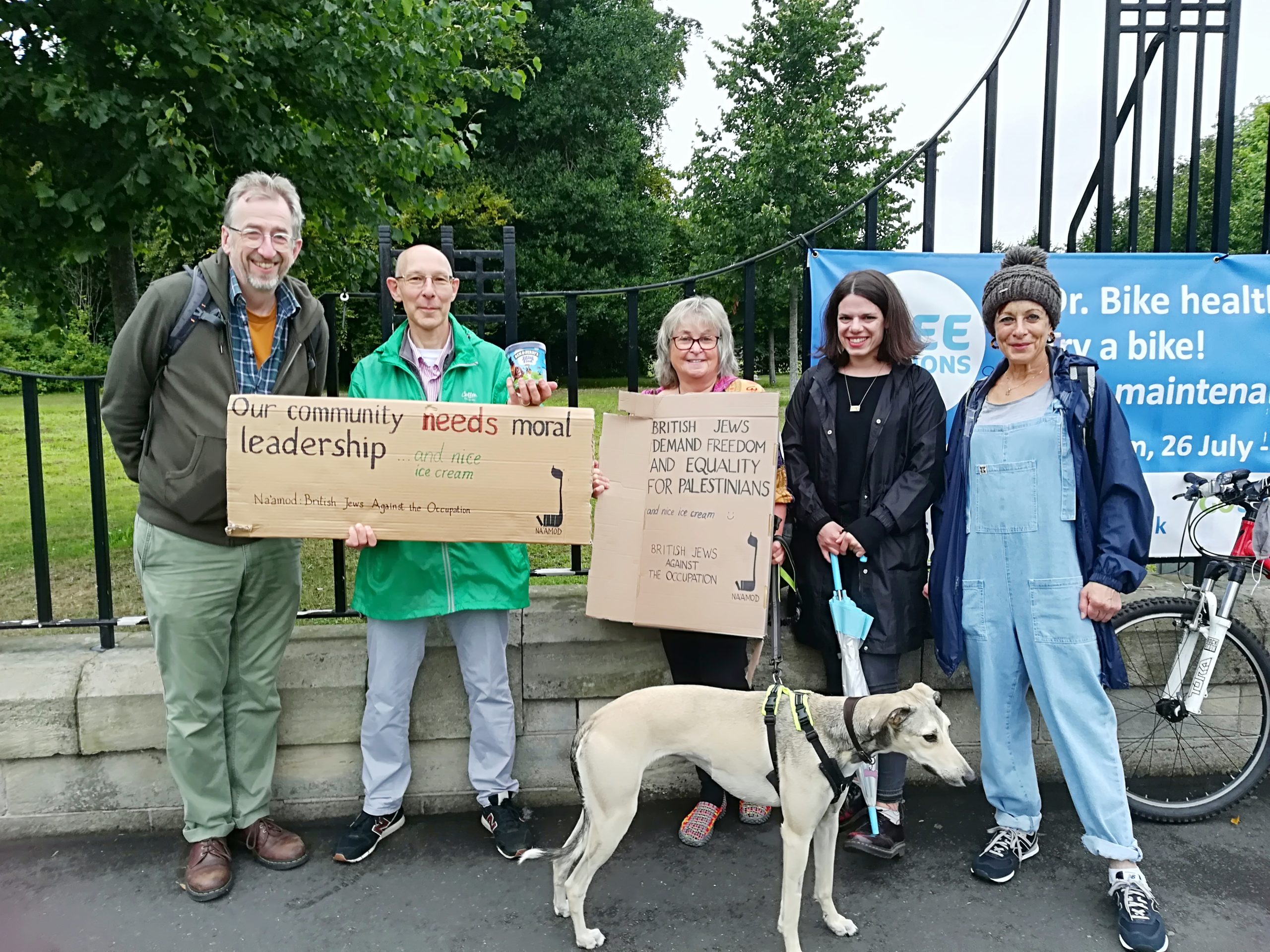
By 2025 Israel’s genocidal assault on Gaza had caused a five-figure death toll. Yet neither the United Hebrew Congregation nor the Reform Synagogue denounced the mass murders or the Netanyahu government’s openly racist policies. Thirty of us could not stomach asking forgiveness for all the wrong things, and instead gathered outside the Civic Centre on Kol Nidrei (1 October) to pray and sing in a setting where we would not have to identify with the overt Zionism of either the United Synagogue or the Reform/“Progressive” movement.
In 2026 we decided to experiment with an alternative minyan on a Shabbat morning in January. To our surprise, 18 people came along. We held a similar minyan in March and every subsequent month. Attendance has held up, suggesting that there are people in Jewish circles whose idea of oneg shabbat (enjoyment of Shabbat) includes singing, Torah study and even davening (traditional prayer) but not standing to attention while someone reads out prayers for the royal family and the State of Israel. I’ve found these occasional Saturday mornings surprisingly full of joy, love, tolerance and relaxation. That’s why I continue to support the minyan.
2 September 2026
Leave a Reply